Any links to Amazon are affiliate links. '
Showing posts with label dressing. Show all posts

Optimal Internal Temp=Optimal Sleep


To sleep "like a baby," your child needs to have her internal temp at the optimal for her temperature. How your child is dressed at night will have a strong impact on how well your child sleeps at night. If your child is too cold, your child will wake up frequently. If your child is too hot, your child will wake up frequently. Just like Goldilocks with her three bears, there is a "just right." Being too hot or cold can lead to not only poor sleep, but nightmares and night terrors. Your goal as a parent is to find what is just right for each of your children.

Some children like to be warmer than others, just like some adults like to be warmer than others when sleeping. Your child's preferences for how to be dressed for sleep at night can change with the seasons, age, weight, and probably the wind. Here are some key things to pay attention to:
  • Socks: In general, when the weather is colder outside, your child will sleep better with socks on the feet. However, some people just hate sleeping with socks on. I have a sock-hating child. This child hated socks even as a newborn. I got lots of passive-aggressive comments from the older people in her life about her lack of socks (even though it was 80 plus degrees outside). If your child likes to sleep without socks, hold strong and true and ignore the back-seat parenters.

    In warmer weather, your child may or may not need to sleep with socks. I love to sleep with socks, but I have a couple of months a year (the hottest ones) where I need to go no socks. 
  • Sleeve Length: In cooler weather, long sleeves is usually a good idea. In cooler weather, short sleeves is a good idea. If your child does not sleep with blankets, or kicks blankets off, long sleeves might be best even in warmer weather.
  • Pants Length: I am sure you are seeing a trend already. In cooler weather, longer pants. In cooler weather, shorts are great. If your child sleeps with a blanket, shorts might be okay even in cooler weather. If your child does not sleep with a blanket or kicks it off, long pants might be best even in summer.
  • Layers: Your child might need to sleep with layers. In colder weather, I find babies need to sleep in layers unless the room is very warm. My babies sleep with socks, a onesie, and footed pajamas or a sleep sack.
I find the main keys to a warm enough child are:
  • Warm feet.
  • Warm arms.
  • Warm "trunk"--this is your child's belly.
There are other considerations for warmth at night:
  • Blanket Use: Figure if and how many blankets to use for your child. For babies, I don't use blankets. They squirm around too much for the blanket to stay on. That is why I go for the layers as I described above. Sometime as a 2-3 year old, children usually can sleep most if not all of the night with a blanket on if needed. 
  • Number of Blankets: Use your common sense here. If the room is warm, a light blanket or even just a flat sheet might be enough. If the room is cool, your child will need warmer blankets. Our children add blankets to the bed in the winter and remove those extras at some point in the spring. 
  • Location of Bedroom: Different rooms in the house are warmer than others. Basement rooms are cooler than second story rooms. Rooms in older homes are usually closer to the outside temperature, especially rooms that are close to the roof. Rooms that are on the West side of the house are warmer at sunset than rooms on the East side, which are warmer in the mornings. 
  • Temperature of Room: The temperature of the room at night impacts how well you sleep. Sleep experts typically range the "ideal" from about 65-75 degrees. Some take it down to 60-70 degrees. You can use fans to cool things off. You can open windows to cool things off until your child goes to sleep. You can use blinds or curtains to block the sun from making the room too hot. You can use a space heater to warm the room up before your child goes to bed. You can keep your home thermostat set at the ideal for your child. You can open or close heater vents as needed. My children sleep with doors closed for a variety of reasons (including fire safety and sound barrier). One benefit is that the temperature of the room seems to stay more constant. Closets are often cold, so if it is colder in your child's room, keep the closet door shut. 
All of these things can be applied to you and your spouse, also. These things impact sleep of everyone. It is definitely worth taking note of these things in your child and yourself for optimal sleep for everyone. 

See Also:

Dressing Baby for Sleeping

How to best dress baby for sleep so baby won't be too hot or too cold. 

How to best dress baby for sleep so baby won't be too hot or too cold.

When cold weather moves in, you will find you likely need to dress baby differently for nighttime sleep (and possibly naps). Here are some ideas for you in dressing baby for sleep.

Experiment
First, some advice. All of my babies have had slightly different preferences for how to be dressed at night. Some liked socks, some hated socks. Some liked to be dressed warmer and some liked fewer clothes on them. You will have to experiment and pay attention to how well your child does/does not sleep with certain clothing. You will want to experiment even down to the fabric of the items you are wearing. A micro-fleece swaddle blanket was the favorite of one of my children, while for another it was too hot for her and she preferred the jersey knit.

Layers
A baby or young toddler will not sleep and keep blankets on; they move around far too much. You also want to be wary of blankets in the crib with babies before they are old enough to move them away from the face on their own while sleeping. 

Because of this, I do layers. My idea is I put the child in what I consider to be the pajamas and then put something over it like a wearable blanket. This might be a swaddle blanket, a sleep sack, or it might be footed pajamas.

Sample Layers
A typical way I dress up my children when they are young are:

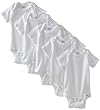
This is pretty consistently the first layer I use for any sleep time of year. This is the basic onesie.


I then add socks. I had one child who hated socks, but the other three all have/do sleep with socks on their feet. We do socks year round. Cold feet are a very common reason for waking early, so I think it is wise to start with socks and then remove them if you think the child does not like socks for sleeping.


Layer Three: Extra Warmth
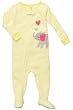
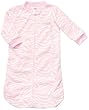
The next layer is extra warmth. If it is cold weather outside and the baby is 6-9 months or younger, I do a cotton footed pajamas like this Zip up sleep and play pictured at the right. If the child is older than 9 months but likes to be extra warm, I will do this layer, also.

For the child who is 9-12 months or older, I will do some basic cotton pants if extra warmth is needed.

If it is warm outside and the nights are warm, I do not add the extra warmth layer. This layer is skipped.

Layer Four: The "Blanket"
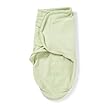
For a baby who is still swaddled, the next layer is a swaddle blanket. That often completes the ensemble. If baby needs more or less warmth, try changing the fabric of the swaddle blanket you are using. 

For the baby who is not still swaddled, there are a couple of options for what to do next. From the time baby is done being swaddled until somewhere around 9ish months, I typically do a sleep sack

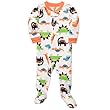
At some point, the baby will start rolling around more and want to be more mobile. Somewhere around 9-12 months, we move from the sleep sack and into the fleece footed pajamas. We stay in this until the child no longer needs layer four. This can be for reasons varying from it is too warm at night for the layer to the child has grown old enough to keep blankets on while sleeping.

Layer Five: The Extra (optional)
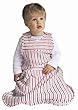
When Brinley was a baby, Merino sent this sleep sack for me to review and I absolutely fell in love (you can see her pictured in it in the first picture on this post). I totally wanted one for myself. This is the Merino Kids Baby Sleep Bag. The one I linked to is the winter weight one and they have a normal weight one. Merino wool is amazing because it is itch free and allergy safe. It keeps the body at the perfect temperature--not too cold and not too hot. The room temperature range to use it in is ten degrees (winter weight is about 59-68 degrees), so no matter what the temperature is in that range, your child will be at the right temperature.

This product is awesome because it takes so much guess work out of it. You will not regret owning this. They also have sizes for 2-4 years old if your older toddlers and young preschoolers will sleep in a sleep sack.

When Brinley was a baby, she was swaddled with this over it. Then we did the sleep sack with this over it (she likes to be warm).

As a side note, there are many other products made of Merino wool, so you can get onsies, shirts, socks, etc.
Room Temperature
Another important step is figuring out what room temperature is best for your child to sleep in. Most sleep experts say to sleep in a room from 64-72 degrees for optimal sleep. A tricky thing is keeping your house warm enough for the baby who sleeps with no blankets and yet cool enough for those sleeping under a pile of blankets (or in the summer, cool enough for the older people while warm enough for the young ones who can't pull blankets off and on as needed).

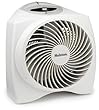
Ever since Brayden was about 6 months old, our babies have slept with the space heater you see above. We let our house come down to about 63/64 degrees and night and keep the baby room at 70 with this heater. For a while, we kept it with the older children as well, but we took them out of all of the rooms except Brinley's last winter. The other children are old enough to sleep with blankets and a space heater can add quite a bit to your electric bill. We try to only use it when the door will be shut so it can minimize the need for it to turn on.

You can definitely sleep with your house warmer at night rather than use a space heater for one room. By about age three, most children can sleep with blankets at night and keep them on.

Conclusion
As you figure out what is best for your baby, remember to experiment with the different layers and see how your baby likes it. Some rooms are warmer than other rooms, some houses are warmer than others, and some climates are warmer than others. 

How to best dress baby for sleep so baby won't be too hot or too cold.


How to Get Your Child to Dress Quickly

One of the hardest things about mornings can be getting dressed for the day--especially if you are going somewhere first thing in the morning. Parenting The Strong-Willed Child has some great tips for making this step easier on the family. In this post I share those ideas along with others I have found help over the years. With school starting (or started for some of you), this might be helpful to think about right now! These tips work whether you are leaving for school, going to dance class, headed off to work, or simply leaving to run errands in the morning. 

How to Get Your Child to Dress Quickly
Lay Out Night Before (PSWC page 225)
I have been doing this for years. It is especially helpful for older children who are getting ready and can dress themselves. I lay the clothes out on the ground. I put underwear first, right side up. I then have the shirt face down and upside down so the child can pick it up and put it on correctly. Then the pants right side up, and finally socks. 

A great thing about having clothes out the night before is that it leaves no room for debating what will be worn that morning as you are hurrying to get ready. It is a great time saver all around. It also makes it so the child can be rather independent. There is no need for the child to wait around for you because the clothes are already set out.

Give Plenty of Time (PSWC page 225)
You want to leave enough time for getting ready that there is no need to rush. You need to be able to be patient. Figure out how long your child needs on the longest day. I know that I have to get Brayden up by 7:30 in the morning so he can have plenty of time for showering, dressing, other getting ready tasks, and eating breakfast. If he is a bit faster, then he has time to play. We both get pretty stressed if he sleeps past 7:30. No one likes to be rushed, and I don't like nagging. 

Get Dressed Before Breakfast
This is something suggested in PSWC and the -wise books. We never really did this until Brayden started school. I must say, if you have somewhere to be in the morning, doing this makes the morning so much smoother! I was pretty surprised by that because it shouldn't really make a difference when you do it, right? But it does. I am not sure why. I don't know if the child is motivated to hurry to get dressed so he can go eat or what. I do really like that you get ready and then eat for as long as you like. There is no cutting off eating for your estimated amount of time needed to get ready and there is no rushing through the getting dressed process because you spent too long eating. 

Walk Away
If your child is capable of dressing himself, walk away while he gets dressed. Tell him to get dressed and then go find something to do. Brush your teeth. Help another child. Set out breakfast dishes. Gather book bags. Read a book. Close  your eyes and rest. Do anything other than hover and nag. 

Play Games
PSWC suggests you play "Beat the clock" to help your child be faster. The -wise books talk about "3 Candy Speed." I typically do a "bet you can't shower faster than I can." You could time your child and see if he can get faster the next day. Come up with what works for you. You might want to mix it up every so often. 

Related Posts/Blog Labels: