Any links to Amazon are affiliate links. '
Showing posts with label solids. Show all posts

How to Introduce Solid Foods to Your Baby

Recommendations for parents for solid foods and babies change frequently and often. Recommendations for solid foods have changed more in my years as a parent than any other topic. The age has changed several times. The list of safe foods has changed several times. The way to introduce has changed and evolved. It seems to be a moving target.

How to Introduce Solid Foods to Your Baby | solid foods | feeding baby | #baby #solidfoods


With that in mind, my first recommendation when it comes to solid foods is to know what is recommended, but also strongly trust your own intuition. Visit with your baby's doctor about it and together decide what is best for your individual baby.

When Baby Should Start Solid Foods
The current recommendation for starting solid foods is 4-6 months old. There is a range because more than age needs to be a consideration. Baby needs to be able to:
  • Sit up well. This does not have to be independent. It can be with support, but she needs good head control and be able to sit up without tipping over when seated in a high chair. 
  • No longer have a tongue-thrust reflex--this is when a baby pushes everything out of the mouth that enters it. It will be very messy and frustrating for you to try to feed a baby who has not lost this reflex.
  • Be interested in food. This is a huge one. Baby needs to want to eat. You can help decipher this desire by having baby around when meals are eaten. If your baby never sees you eat, you will never have any idea if baby is showing an interest in solid foods or not. An interested baby will watch you eagerly and reach toward food.
When To Do Solids in Your Routine
When I am initially introducing solids to a baby, I will nurse one side, feed the solid foods, then nurse the other side. I do not  feed all of the liquid at once while baby is learning to eat solids. I want baby hungry and eager to eat the solid foods. As the baby gets used to eating solids, you can do the full liquid and then the solids.

You want the solid foods to be a part of the liquid feeding. You do not want to nurse/bottlefeed, wait a while, then do solids, then do nap. That turns into feeding every two hours or snacking throughout waketime. If your baby could go three hours between feedings as a newborn, so can your six month old. Many can even go four hours between feedings at this age. 

Which Feedings To Offer Solids to Baby
There is no one universal right answer to this. When you initially start, you might just do one feeding a day. Just pick the feeding that is most convenient to you, but pick one that is close to when a meal time will ideally be (breakfast, lunch, or dinner). As baby adds more feedings, you will work up to three solid feedings a day. 

How To Start Solid Foods
There are many options for exactly how to start solid foods. Here are two methods I used. 
  • Slow and Methodical: The slow and methodical approach is to introduce solids slowly and by group. I started with the simple, basic rice cereal. I fed just 1/2 T of rice once a day. After a couple of days, I would move that to 1 T (so long as things were going well). I would slowly add more food every couple of days until we reached the amount the child wanted in one meal. I started with small amounts so if the food didn't agree with the baby, baby didn't have too much of it in the system.

    The second week, I added that same food to three meals a day.

    I slowly added on from there, going by certain colors of veegtables (yellow veggies first, then green). Then I slowly added fruits. This whole process took about two months to complete. For lots of details on the process, see my post Solids: How to Start? I used this process with my first two babies.
  • Slow but Random: With my next two babies, I still took things slowly, but I went more random on the order I introduced foods. I skipped rice by then. I liked to start with banana or avocado (one of my babies had a bad reaction to avocado though! So odd). I still went slow, but I didn't worry about what color the food was or even if it was a fruit or vegetable. By this point, I was making my own babyfood, so part of what drove the decision on what to feed was what was in season. What could I get in bulk and make a lot of at a reasonable price.

    The trick with random introducing is you need to be sure you leave enough time in between new foods that you can track and trace if your baby has an allergic reaction. Otherwise, you have to cut everything and slowly reintroduce. You can read 
  • Baby Led Weaning: Another popular way to introduce solids is to go with Baby Led Weaning instead of using pureed food. This is not something I have done, but a lot of Babywise mamas love it. You can read some information here and see if it is something you would like to do. 

Baby's Feeding Schedule With Solid Foods

When it is time to start solid foods, the daily schedule may shift some, but your pattern should stay the same. This post outlines when and where solid foods should fall in your baby's daily schedule.

How to work feeding baby solid foods into your daily schedule

One of my favorite stages with babies is introducing solid foods to them. Even when you introduce a food they love, their reaction to the first bite is often worthy of an America's Funniest Home Videos entry. The nose gets scrunched up, the eyes may shut, and a shiver runs through the body. You can rarely tell if your child will love a food or not from the first bite.

While starting solids is entertaining, it can also be confusing. When you are going through giggles, you may also wonder when your baby should be eating those solid foods. Right with the liquid feeding? Should it be spaced out? What is the right call? I have the answers for you.

Don't make the mistake of feeding baby too often.

I often get questions that go something like this, "Hello! My six month old hasn't been sleeping well since we started solids. Can you see something wrong in our schedule?

7 AM Nurse
9 AM Solids
9:30 AM Nap
11 AM Nurse
1 PM Solids
1:30 PM Nap
4 PM Nurse
6 PM Solids
7 PM Bedtime"

I immediately know what the problem is when I see that schedule.

Do you see it?

Baby, who has been breastfeeding or bottlefeeding every 3-4 hours, is suddenly being fed every two hours instead of every 3-4 hours. 

A six month old does not need to eat more often than a six week old. 

From the time you brought your baby home from the hospital, you worked on establishing a 2.5-3 hour routine, which meant baby ate every 2.5-3 hours. As young as five weeks old, some babies can go 2.5-3.5 hours. By four months, many babies are on a four hour feeding schedule. 

Then we introduce solids and feed them every two hours.

Sure, there were times baby ate every two hours, especially during growth spurts, but that was never what you were aiming for. If your baby tried to consistently eat every two hours, you would have scoured the book, blog, and/or fellow Babywise mom brains for help on getting that feeding interval longer. 

When your baby starts solids, stick with the 3-4 hour interval in your routine. 

Stick with eat/wake/sleep. When your baby wakes from nap, start with your liquid feeding. Then move on to solids. Feed as much solid food as your baby will take--do not force more and do not limit it (unless you have been instructed otherwise by your baby's pediatrician). Once your baby is done eating the solids, have playtime. Finish up with a nap. Once baby wakes up, start the cycle again.

If your baby is really not hungry at all for any solids, you can feed half of the liquid feeding, do solids, and then feed the other half. If you are breastfeeding, you feed one side, solids, second side (or do half time if you do single-side feedings). If you are bottle feeding, do half of the bottle, solids, then second half of the bottle.

Feed baby solids three times per day.

How to work feeding baby solid foods into your daily scheduleThat will mean that if you are on a four hour schedule with no dreamfeed, so you are at four feedings a day, your baby will not eat solids at every single meal. Pick three. The three you pick really don't matter in general; it just matters that you pick the best three feedings for you and your baby.

You might pick your first meal of the day so that it is like "breakfast." You might skip that first one because you have so much milk and your baby isn't hungry enough to add solids. Feeding solids adds a fair amount of time to your feeding time, so you might base when you feed solids based on what your daily routine looks like. If you have a 3 PM feeding and need to pick other children up from school at 3:30, for example, you might not want to do solids at 3 PM. I have had solid meals at different feedings among my four children. I always did what made the most sense with each child.

Another note, you want to get to three solid feedings per day at some point, but you don't start there. Start with one. Give it some time (at least a few days, but maybe even as long as a couple of weeks) before adding a second. Give it some more time, then add your third.

Feeding solids is not as confusing to work into your daily routine as it might seem at first. When you started a schedule with your baby in the beginning, you were starting as you mean to go on. Go on as you intended when you started. Feed the entire meal, milk and solids, at once. Feed every 3-4 hours. Land at 3 solid feedings a day. Do those things and you will be on the right course!

Related Posts:

Why Breastfed Babies are at a Higher Risk for Iron Deficiency, & What to do About it {Guest Post}

Why iron is so important for breastfed babies.

When it comes to feeding your baby solid foods, there is one very important mineral to keep in mind- iron. Babies are actually born with a backup of iron stores. These iron stores supply iron to your little one for approximately the first 6 months of life, until they are depleted around that age. So, what does this mean exactly? It means you need to get iron into your baby so they don't get deficient.

The next question is if the baby is breastfed or formula fed.

Formula fed babies are getting the iron they need from the formula they are drinking. Most formulas are iron-fortified. This means you don't have to worry about iron deficiency.

Breastfed babies, on the other hand, do not get enough iron from breast milk. Breast milk actually contains very little iron. As a result, breast fed babies actually need some form of supplementation to get the iron that they need, otherwise they are at risk for being deficient. So, at 6 months of age, it is no longer safe to 100% breast feed your baby. There has to be supplementation somewhere.

Most parents are thinking about starting solid foods somewhere between the age of 4-6 months, with the trend now being to start at 6 months. My only caution with this, is that many babies don't take to solid foods quickly, so if you are breastfeeding your baby and only start introducing solid foods at 6 months, there needs to be a quick turnaround on acceptance of the food, and a high focus on iron intake, in order to be sure your little one is getting enough. As with everything, every choice you make needs to consider everything that is right for your little one. The recommendation to start at 6 months is only part of the big picture to keep in mind.

The next question, is where do you focus in order to increase iron intake? 

There are several good options:

1. Introduce a liquid vitamin that contains iron. Your 6-12 month old baby needs 11 mg of iron per day.  Vitamins are a simple way to accomplish this goal.

2. Don't be afraid of cereals. There is a rising trend to skip baby cereals because they "provide little to no nutrients". This is not true! I go in to more detail of the science behind their nutritional value in this post on introducing solid foods to your baby, but the short version, is that cereals are easy to digest. They are a great place to start when the digestive system has had nothing but liquids to work with. Oatmeal is a whole grain. Whole grains we obviously known to be healthy. So, feel free to skip rice cereal, but don't overlook the option of oatmeal. These cereals are not only easy for our little ones to digest, they are fortified with iron! You can get pretty creative with these cereals and even make them into baby pancakes once your baby is chewing.

3. Introduce iron rich foods as soon as possible. Meats, beans, grains, and vegetables are all good sources of iron. A full list of iron rich foods can be found at this link. Nothing compares to the levels that baby cereals provide! Chicken liver comes in second, with white beans and spinach at the next highest levels.

4. Shy away from dairy with meals. Calcium can actually inhibit the absorption of iron. So, try to feed dairy items high in calcium, as snacks away from meals if possible.

5. Include high levels of vitamin C.  Vitamin C aids in the absorption of iron. This means you need to include lots of fruits and vegetables in your baby's diet to help iron get processed in the right way!

As with any decision you make, it is important to have the full picture. Trends are trends. Science can help give us more insight. Iron is so essential to our diets and our health, and unfortunately, we talk more about trends than scientific facts at times. The scientific fact is that babies need iron supplementation starting at 6 months of age, and breastfed babies are at a higher risk for iron deficiency. 

Katrina has a 2.5 year old daughter and blogs at Mama's Organized Chaos. She's a mama that breastfed, used cloth diapers, did sleep training, and loves Babywise!

Other posts of interest:


Why iron is so important for breastfed babies.

Babywise Friendly Blog Network


Super Baby Food Book {Giveaway}


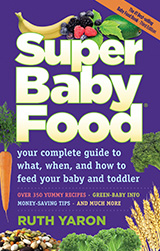
If you have been around for a while, you know I love, love, love this book. Super love Super Baby Food by Ruth Yaron. This book is just full of information. It actually has more information than I could ask for, which is huge. I don't find it lacking. It is the best resource I have found on feeding food to your child, from baby on up.

Here is a bit about Yaron:
When Ruth Yaron’s twin boys were born premature and very sick, she knew the most
important thing she could do for them was to feed them the healthiest diet possible.
Unhappy with the information that was available to her, Ruth decided to do her own
exhaustive research on nutrition and health food. Although she was a whiz at
programming satellites for NASA, Ruth was an inexperienced cook. She used dozens of
natural cookbooksto learn her way around a kitchen, experimenting with tofu, carob and
wheat germ,much to the surprise offriends and family.
Ruth Yaron graduated from East Stroudsburg University in Pennsylvania with degrees in Mathematics and Computer Science. She worked at the GE Space Division and programmed satellites for NASA before writing Super Baby Food. She isthemother ofthree sons and lives with her husband in Scranton, PA. 

Super Baby Food is now out in Third Edition. This is new and updated to include the current guidelines on allergies and introducing foods. And guess what. This is an exciting moment in my life. You know how books have those little endorsements? Well, if you open up this book, the first page has a list of nice things people have said. You will see a nice comment from Martha Stewart, and if you turn the page and read the last comment, you will see one from ME! Yes, that is right. Me. I wrote an endorsement for this book. I feel special. I guess if you ramble about how awesome a book is for years you just might get asked to officially endorse it some day.

Here is the link to the website: http://www.superbabyfood.com/

If you want to know previous thoughts on the book, see this post:

  • You must enter the giveaway to have an entry.
  • No entries are mandatory--you can enter using one or all options. But as I said, you do have to enter to have at least one entry.
  • You must fulfill the rules of each entry for each entry to count. If I see the entry is not valid (did not meet entry requirements), I will disqualify your entry. Trust me, I check.
  • Entries will be accepted until 12:00 AM September 27, 2013.
  • The winner will be randomly selected through Rafflecopter.
  • The winner will be announced sometime after the winner is chosen. I will email the winner.
  • Once the winner is announced, you will have one week to contact me or another winner will be chosen. Be sure to check back and/or check your email. The only thing worse than not winning is to win but not realize it in time.
  • I will not use your email address for any purpose other than contacting you if you are the winner (and FYI, I don't have access to the email addresses except for the winner).
  • US shipping addresses only.


Solid Food and Babies


Guess what. I am getting old. I have entered a phase in parenting that is kind of mind blowing for me. Advice that was given to me when Brayden was a baby is now outdated. And it has changed a few times.

When Brayden was a baby, the recommendation was to start solids at 4 months old. You did it slowly over time. There were a lot of restrictions on what could be given at what ages because you didn't want to cause food allergies. Things were the same for Kaitlyn, though some were starting to suggest waiting until 6 months for solids. 

When McKenna was a baby, there was starting to be some questioning as to whether previous recommendations were really the right way to go or not and things were sort of up in the air. Today, things are very different. And that leads me to this post. I have quite a few posts on solids, but all of the "how-tos" were written almost 5 years ago and are pretty much obsolete now. Foods that we were supposed to avoid because they would cause food allergies we are now supposed to give to avoid food allergies.

TRUST IN YOURSELF
As you are introducing foods to your baby, trust yourself. Listen to your "gut." This is my advice in all parenting choices. Yes, it is good to know what is recommended, but the medical community obviously does not have all of the right answers. 8 years ago, if you gave your baby strawberries, peanut butter, or milk before a certain age, your child was sure to have a food allergy to that food. Today, if you don't, your child is at a higher risk to have a food allergy to those foods. 

Here is my point. Recommendations change and change rapidly. Do your research and then decide what you think is best for your baby. 

WHAT AGE TO START SOLIDS?
The recommended age to start is something that changes quite often. It has changed a number of times in the 8 years I have been a parent. In the early 1900s, recommendations were to wait until after one. Not too long ago (30-50 years), recommendations allowed for as early as 4 days old. 

They are back to saying four months is okay, but you don't need to start at four months. The range is typically 4-6 months--there is debate on whether 4 or 6 is best. Again, go with what you think is best. 

The best thing to do is start when your baby seems very interested in eating solid foods. I have started my babies when they have started leaning toward food we are eating at meal times with their mouths open.

A huge indicator in if your child is ready or not is when the natural tongue-thrust reflex goes away. Babies are born with the reflex to push things out of the mouth. Once baby loses that and is able to swallow (more than liquid), it is a good physical sign that baby is ready.

Another physical sign is when your baby can sit unsupported.

My recommendation is to first wait until 4 months old. You might prefer to wait until 6 months or later and that is totally fine. Then start to watch baby's interest. When interest is there, analyze the tongue-thrust reflex. If it seems like baby could swallow food, give it a try!

WHAT DO YOU FEED BABY?
Things are simple today. Much more simple than they were with my first two. 

First Feedings
First, start with the simple foods that are universally easy on the tummy and are not foods people are usually allergic to. Many people like to start with some sort of cereal like rice or oatmeal. Other good first foods are sweet potatoes, bananas, and peas. 

Moving Forward
Recommendations are now that if a baby has tolerated these simple, non-allergenic foods and is 4 months or older, you can introduce almost anything baby can chew (but do not feed a baby raw honey). How long does a baby have to have eaten foods to have "tolerated" them? I don't know. I would recommend at least two weeks. For my babies, I would do 4 weeks of historically "safe" foods before I got adventurous. This article is a great read on introducing allergens.

Previous Posts
Here are some posts I have written that will help you with the "what":
First, choose what food you want to start with. See above. 

Second, set things up. Have your food read. Have your chair ready for baby to sit in. Have your camera and/or video monitor ready. Have it all ready before you get baby sitting and waiting.

Third, sit baby in the high chair/seat. Put the bib on.

Fourth, pray with your baby if you are a family that prays before meals. Do this each time you feed your baby.

Next, put a bit on the spoon. Make sure the food is a good temperature (not too hot). 

Next, put it in baby's mouth. See what happens! Take photos (I like to do this with my husband taking pictures so we capture the moment). Some babies will love it. Some will gag. Some will shudder. Some will swallow and open wide for the next bite and some will spit it all back out and clamp their mouths shut. Don't be discouraged if a lot comes out. This is totally normal. This is a new skill for baby to learn. Your baby likely will not be very good at it at first. See: 

Gear
What kind of gear will you need? It is very simple. This is what I like:
  • High chair (or some sort of chair for baby to sit in)
  • Bib
  • Spoons
  • Bowls
  • Wash cloth for cleaning hands/face
3-5 Day Wait Rule
In detail, I described your first feeding session. No matter what food you want to introduce next, remember the 3-5 day wait rule. Wait 3-5 days between each new food so you can watch for allergic or negative reactions to the food. So do one food day one. Wait 3-5 days before you do a second food. Do that each time you introduce a new food. Do not introduce mixed foods (like, bananas and sweet potatoes) until your baby has had both successfully.

Baby-Led Weaning
Baby-Led Weaning is a different way on feeding your baby. It involves using chunks of food and no purees. See this post if that is of interest to you:
Previous Posts
HOW MUCH DO YOU FEED?
Start with only about 2 tablespoons of food. Not much! See how that goes and then increase from there. 

Once you have baby eating 3 meals a day, the amount will vary from child to child. I have had babies that ate a whole lot of food and those who ate not so much. Let your baby guide you in deciding how much to feed her.

WHAT IS THE FEEDING SCHEDULE?
For your first meal, choose a time of day that works best for you. I like to do breakfast or lunch so if an allergic reaction were to happen, it would hopefully happen during the day and not the middle of the night when I wouldn't be at 100% capacity for dealing with a strange situation.

I feed solids with the liquid feeding. So I start with breastfeeding the baby, then we feed solids. The Baby Whisperer recommends doing the liquid feeding and then two hours later, feeding the solids. I have two reasons for not liking this approach. One is that it takes a baby who was nursing every 3-4 hours and now has baby eating every two hours all day. I think you risk creating a snacking problem. Second is that it leads to an overly tired baby. A baby should be up for two hours, not up for two and then eating a meal. Plus, you are then feeding solids to a baby who is ready for a nap, and this will mean it is harder to keep baby interested and listening to you. You can read more here:

Initially, you can feed solids just once a day. I would do just once for the first few days. Then you can start to add other feedings. You will want to get to where you feed at breakfast, lunch, and dinner. Choose the feeding that is closest to those times no matter how many feedings you have in a day. I have a detailed post on when to schedule in solids  here:
For planning out what to feed for the week, remember to feed the rainbow. And you can use my free printable to plan it out if you like. It is here:
HOW DO YOU TEACH MANNERS?
Once you have all of those details down we have talked about so far, you want to start thinking about manners. Basically, when baby does something you don't want her doing long term at the table (like thrusting her hand into a bowl of carrots), don't freak out. If you have a very entertaining reaction, she will naturally want to see that reaction again. Calmly remove her hand, wipe it up, and let her know to not do it again. Then show her where her hand can go instead.

With some things, I like to initially ignore the behavior. So if a baby starts blowing raspberries or does a nice high-pitched squawk, I just ignore it. If it continues, then I let the baby know to not do it at the table. 

Remember to allow things you want to continue and disallow things you don't want to continue. Consistency is always key when teaching your children. Here are some posts to help you:

HOW DO YOU AVOID PICKY EATERS?
I have had three children I would say are definitely not picky and one who I would consider picky. Let me tell you, having a child who is a picky eater is difficult! It is so worth doing what you can to avoid the pickiness. I have several posts on this; I will link them here:
The day will come when you and/or your child will want to move from purees to eating table foods or finger foods. You will want your child eating basically whatever the family eats. See these posts for tips.

CONCLUSION
There you have it! As you go through this process, trust in your own judgement. Consulting with your baby's doctor is always a good idea. And here are some good books:

Making Baby Food

Making baby food is really quite easy to do! There are entire blogs and large books published on the topic, so this will not be an inclusive post on how to make all baby foods, but rather a post that breaks it down into the basic steps so you can see how easy it is and consider venturing into the world of making baby food. You can see my post "In Action: Making Babyfood" for more information and for reasons why I think you might like to do so.


Here are the basic steps in making any food.

STEP ONE: COOK THE FOOD IF NEEDED
For any vegetable, you will need to cook it. For younger babies, fruits will need to be cooked until six months old. After that age, you don't necessarily need to cook a fruit. 

You can cook the food any way you like the food cooked. My opinion is that veggies taste better baked than boiled or microwaved, so I bake my food for my babies. For carrots, I cook them in the slowcooker. Whatever method you choose, you want the food to be very soft when done, so steaming might not be the best method for baby food for certain foods--I guess unless you steam it longer than I would steam for myself. I like my steamed veggies crisp. You can easily search recipes on the nice worldwide web for how to bake, microwave, boil, or slow cook vegetables.

Cooking Tip: For cooking sweet potatoes, put a drip pan or a cookie sheet on the rack under the sweet potatoes. You cook them on the rack, but the juices will start to drip out at the end. With a drip pan or cookie sheet, you can just clean that up instead of having to clean your whole oven.

STEP TWO: REMOVE SKINS
If you microwave or boil your vegetables, you will remove skins before you cook them.

Sweet potatoes will literally just drop out of the skins when they are baked. I just take them out of the oven and let them cool enough that I can work with them without burning my fingers. I then cut them in half and let them cool more if I need to. I then hold it over my Cuisinart and just let the flesh drop out. 


For squash, I use a cookie scooper as pictured above. I scoop the squash out and drop it into my Cuisinart.

cooked squash

 If you are not cooking your fruits, you might want to blanch the fruit to aid in skin removal. Blanching sounds ominous before you try it. Google ways to blanch for videos or tutorials. Basically, you have a pot of boiling water on the stove and a sink full of ice cold water. You put your food in the boiling water for usually 1-2 minutes, then remove and put it in the ice cold water. The skin will then easily slip off (if the fruit was ripe--under ripe fruit doesn't blanch so well). 

STEP THREE: PUREE FOOD
One way I puree the food is in my Cuisinart Food Processor. I put any food I have in large quantities in this. For example, I do squash, sweet potatoes, carrots, peas, prunes, and green beans in this.

Another way to puree the food is with a Baby Food Mill. I use this for my bananas and avocados. You could use it for strawberries if you wanted to puree them. I will also use it to quickly puree some pears or peaches that I have preserved in mason jars. You could do smaller portions of the other foods in this, too. So if you made squash for the whole family, but wanted to puree some for baby, you could do just one portion in this.

I also use this for squishing up my bananas for banana bread. It is an inexpensive baby tool and I find it useful beyond baby food.

You can also use the old fashioned method of a fork to smash things up. A blender works great as does a potato smasher.
Food Mill


STEP FOUR: FREEZE THE FOOD
The food will last for a couple of days in the refrigerator, so I save a couple of portions for baby in the fridge. The rest goes into ice cube trays. I scoop it using a spoon or my cookie scooper. I use traditional trays and the trays from Fresh Baby. I like the Fresh Baby ones best. The lids help keep the food fresh and you can stack the trays easily.

Once it has frozen (usually about 12 hours) you can move it into freezer bags. I write on the bag with a permanent marker with what it is and the month and year I made it. Then each morning, I get out any cubes I need for the day and put them into baby bowls with lids.

CONCLUSION
See! Four basic steps to making your own pureed foods. I make enough at once that I only have to do it every few months. For keeping track of what you have introduced and what you plan to introduce, check out my free printable Baby Meal Planner.

RESOURCES
There are two resources I like best. 
  • Wholesome Babyfood.com: This is a great site, and is really the only resource you would need. Something nice about a website is that it is dynamic and they keep current recipes on the homepage. It offers lots of different recipes for each food. If you check out the avocado section, you will see several different ways to prepare avocado for your baby. This isn't really necessary; baby is fine with the same old thing over and over, but you might find it fun.
  • Super Baby Food : This is my favorite resource. I am more of a book person than a website person. I like to have books to look through. I keep this book in my kitchen with my recipe books. This book is worth it even just for the section on how to choose, store, prep, make, and keep all fruits and veggies. I use it for the whole family! If you prefer books, I would get this.
  • Fresh Baby So Easy Baby Food Kit: I use this book for quick reference in finding what ages foods are recommended for. This book has fast microwaving tips. It also has great ideas for spices and herbs that go well with different foods. 

Reader Questions/Comments to Each Other

Four Hour Schedule

  • LHS Class of 1998 said...
    Hi Heather,I was following your question a few weeks ago to Val about moving to the 4 hrs schedule. I was wondering how that was going because I am running into the same issue. My 6 month old is totally ready for the 4 hr schedule but his naps don't stretch the entire way and I end up having to entertain him for 30-45 minutes before he is ready to eat. I can't feed him at even 3 1/2 hrs because he is not interested in the least but right at 4 hrs he is HUNGRY. This is totally frustrating because our old 3hr schedule was perfect and easy, we have been doing BW since day 1. But it is so nice to know that you are not alone in this wonderful journey!Thanks! (And thanks again Val for creating this wonderful community of Babywise mommies!)Megan
    May 19, 2008 8:43 PM
    heather said...
    Megan...Yes! It's so glad to know we're not alone! :) I have to be honest and say that we're not exclusively on the 4-hour schedule yet. It really depends on her naps! The one difference between our children is that my daughter will eat anytime i offer to nurse her!!! So, whether that be at 3 hours or 4 hours, she's ready to eat! Because of that, I often give in and feed her if she wakes and it's been 3 hours. I've conditioned her so much to expecting to eat when she first wakes that it's hard to put her off for very long, which is another reason I don't make it to the 4 hour mark at times. I need to work on that! How long does your baby stay awake at a time? Just curious! We usually go around 2 hours, except for early evening is usually longer. It seems like her third nap begins/end too early. ???
    May 20, 2008 6:22 AM
    Elizabeth said...
    I also went through Megan's situation with my son (now 7 months). We moved to a 3 1/2 hour schedule at 5 months, and a 4 hour schedule at 6 months. Since then, his naps have not always perfectly ended right at the time of his next meal. At first I was nervous about this, but he was sleeping enough to wake up happy, and wasn't fussing during that "in-between" time. Consequently, I just let him play until it's time to eat, and he does great. As long as he sleeps 90 min to 2 hours, and wakes up happy, I just consider it "bonus" playtime for him (or cuddle time with mommy in the rocking chair!). The most important thing, at least in our home, is that he wakes up well-rested.We also had the 4-month nighttime troubles, even though Noah had previously been sleeping through the night since about 9 weeks. At first I would get up and nurse, and then later switched to giving him his paci instead and he would still fall back asleep once he had it. My doctor (who is a Prep for Parenting supporter) advised me to let him CIO, since he obviously didn't need the calories. He called it a "trained night crier", and that Noah just needed to learn to self-soothe. Sure enough, after about a week of CIO at night he stopped waking up, and has only had troubles since when experiencing occasional growth spurts.
    May 19, 2008 11:27 PM
    LHS Class of 1998 said...
    Thanks Elizabeth for that great perspective! Waking up happy from naps is wonderful even if before the schedule feeding- this was a major step for us because I had my fair share of the 45 minute naps with my son who just wouldn't go back to sleep (with extensive CIO) and ended up cranky.Heather, yes, sounds like we are dealing with the same issues:-) I also felt like I conditioned my son to eat right when he woke up when we were on the 3hr sch, but after a few times of waiting he was fine. He does play happily now until meal time which I was also nervous about as Elizabeth mentioned above. At 6 1/2 months he usually can only stay awake for 2 hrs - 2 1/2 hrs, except the first cycle once he get up in the morning, he can only last about 1 1/2 hrs until his first nap. I am guessing that once these can be extending his wake times and feeding times will match? Anyone else have experience/encouragement they can share?Megan:-)
    May 20, 2008 9:12 AM
Naps
  • Erin Martin said...
    I started my son on BW at 5 weeks. He is now 8 weeks and doing better with napping and night time sleep, paricularly with night time sleep. We are still having troubles with naps ending too soon. I started him on mainly a 3 hr routine to start the day off and ending the day at 2 hrs. This was a suggestion made by a contact mom to help him sleep better at night. So our day starts at 7am then 10am, 1pm, 4pm, 6:30or6:45, 9pm and 11pm, 3:45am or 4am to finish the middle of th night. My son can never make it to the next feeding with the 3 hr schedule during the day but is hard to wake up to feed at 9 and 11pm after he goes down for the night around 7pm. He usually stays awake about 1 hour (including eating) during the day and then will sleep about 1- 1.5 hrs (sometimes with intermittant crying, but lessening as we go) leaving us with 1/2 to 1 hr before he's hungry. Most times I let him CIO because I know he's not hungry but rarely I will get him up. I feel bad not knowing if he's really still tired and should CIO or if he's ready to get up or if I should shorten his waketime to 45min. I've tried shortening waketime a few times but he still wakes up earlier and it may be due to us starting BW late. He will usually fuss after I get him up so I feel he's still tired, so maybe he just needs longer with CIO since he isn't hungry sooner than 3hrs or should I decrease his intake and go to 2.5 hrs and see if he's hungrier then? Maybe I should give it more time at the 3hr schedule or will I confuse him by switching to a 2.5 hr schedule of 7am, 9:30am, 12pm, 2:30pm, 5:00, 7:30, 10pm and Middle of Night feeding? I know I would be skipping a feeding in the evening but he is hard to wake for the 9pm and 11pm feeding anyways and isn't that interested in eating. I know we started BW late, but should I expect him to sleep through the night soon since he's be only getting up once during the night between 11pm and 7am since he was 6 weeks? He is also consistently waking at 3:45/4am everynight and doesn't seem that hungry at that time either and referring to the book, I feel he may be one of those babies stuck on an internal clock, but I don't want to let him CIO at night unless he's ready. He's over 14lbs now, so he's larger than most babies his age and seems to be doing many things more quickly than most babies, but I want to be realistic in my expectations. I just want to do what is right by my son. Any help you can offer is much appreciate.Erin
    October 20, 2008 7:18 PM
    Plowmanators said...
    Stephanie, Jenny, and Erin, I apologize--I missed all of your comments until now! If you are still having trouble, please let me know.
    November 10, 2008 3:28 PM
    bando966 said...
    Erin Martin,I read your last post on 10/20 and was wondering how your are doing now? I'm experiencing a similar situation with my 6 week old and wanted to see if you had made any progress and if so, what worked for you?Thanks!
    November 10, 2008 8:06 AM
    Erin Martin said...
    bando966,My son is going to be 12 weeks tomorrow and doing so much better.He started lengthening his naps to stretch our 3 hr schedule and I actually have to wake him half of the time. I'm not sure if there was a trick to it. I think since we started BW late it just took a little longer to get into a routine. One thing I did do, was when he would wake early and wouldn't go back to sleep after 10-15 mins of CIO, I would just get him up and play until feeding time. I thought it might mess up our schedule but it has worked out well and like I said, he usually sleeps straight through to the next feeding. I'm glad I did not change to a 2.5 hr schedule because he does not need to eat that often. I also did not keep up feeding him at 9pm and 11pm. It got to be too much for him to eat. Our schedule is:7a, 10a, 1p, 4p, 7p, 10:30p He has also been sleeping around 7-8 hours at night for the past 2 weeks. I had to let him CIO a couple of nights since he was stuck at waking 3:45am and not wanting to eat, so I knew he was one of the babies stuck on his internal clock. I am preparing to drop his 10:30p feeding in the next few weeks after he's been STTN longer. He's usually hard to wake then and not seeming too hungry so I think it shouldn't be too difficult. BW seemed difficult to implement in the beginning but has gradually become the structure my son and I needed. Let me know how things go. Erin
    November 16, 2008 8:10 AM
    Plowmanators said...
    Erin, I am glad things have improved for you!
    November 22, 2008 4:16 PM
Night Issues
  • Libby said...
    Hi.I have a 4 1/2 month old who sleeps well during the day. He has a little cry, then soothes himself and straight off to sleep. But at night time he is very unsettled and doesn't want to go to sleep. At about 5 or 6 I give him a bath, then massage, and then put him down for a nap. He has a big cry, and gets really worked up. After about 40mins I go into his room and put a pacifier in and hold his hand and stroke his forehead. He takes a while to calm down but then does go to sleep till his late night feed. Why doesn't he settle himself at night? and any ideas of what to do?
    October 23, 2008 8:06 AM
    Beth said...
    Hi Libby-He may be ready to give up that late night nap. I was just looking back through my copy of Babywise and it is around 4 months that babies can go to 3 naps a day and give up the late afternoon/early night nap. It might help to try it and see.
    October 23, 2008 11:50 AM
    Libby said...
    Hi Beth,thanks for your comment. I had thought that might be the case. He is showing tired signs, unless that is normal for that time of night (eg. 5-7pm) and I need to just push through it. What time should a 4 1/2month baby be going down to sleep at night? And what routines have worked well?
    October 23, 2008 6:52 PM
    Beth said...
    Libby-My baby is 3 months old, but with my little girl who is almost 3, I did a schedule like this at 4-5 months. I nursed every 3 to 3 hours 15 minutes. I didn't move to a 4 hour schedule nursing until she started eating solids simply because I wanted to be able to keep 5 feedings a day. Some people go down to 4, I just preferred 5 and that worked well for us (I didn't start solids until 6 months). So our schedule looked something like this: 7 am nurse, 8:45 nap, 10:15 nurse, 12 nap, 1:30 nurse, 3:15 nap, 4:45 nurse, maybe a short nap maybe not, between 7:30 and 8 nurse and right to bed. She would then sleep until I got her up around 7 the next morning. When she started solids at 6 months I did 7 nurse, 9 nap, 11 nurse, 1 nap, 3 nurse, short nap around 6, 7 nurse and bedtime at 8. I offered solids at the 7, 11, and 3 nursings after I nursed. We gradually moved to a schedule more like this 7 nurse and breakfast, 9 nap, 11:30 nurse and lunch, 2:00 nap, 5 nurse and dinner, 8 nurse and bedtime and we kept that until she was 1. Hope this helps!!
    October 27, 2008 7:08 AM
    Libby said...
    Beth,Hi, thanks for the info about routines, etc.. it has been very helpful and has given me confidence with what I am doing at the moment with routines. Since holding off his sleep times late afternoon he has been going to sleep without all that crying. He still has a short sleep of about 30mins then wakes for a feed at about 7-8pm, then sleeps all night. Thanks again
    October 29, 2008 1:17 AM
Solids
  • blessedwife_mom said...
    This blog is such a wonderful resource. Thank you for all of your great topics. I have a question about solids and dreamfeeds. My LO is 5 months old and has slept consistently through the night(8:30pm to 7:00am without a dreamfeed) for about 2 months. Well, a week and a half ago I introduced her to solids and ever since then she has been waking up early between 5:30am and 6:30am. So to intervene, I started doing a dreamfeed at 10:00 or 10:30. The few nights I did not do a dream feed, she woke up early. With the dreamfeed, she will sleep until 7:30am. Is this normal for a baby to wake up starving even when she is eating more now than before? I try to have her eat more during the day, but she is BF and when she stops eating, she will NOT eat more! She has 5 liquid meals a day and 2 solid meals (cereal) a day. Is there a correlation between starting solids and early waking? I don't think it's gas pains. It's hunger. Do you have any suggestions about the dreamfeed? I feel like we have taken a step backward. Also, I had planned on moving to a 4 hour feeding schedule, but I can't if she won't sleep 12 hours at night.
    October 10, 2008 4:04 PM
    Emily said...
    blessedwifemom...I know I'm not the person you asked ;) But I went through this with my second child. Solids do help some kids sleep through the night b/c their tummy is full, but solids actually have WAY less calories than breastmilk or formula. so the baby feels full b/c the solids digest more slowly, so they take less formula/bm, so then they end up getting too few calories and wake up at night!! It isn't a problem for babies who eat plenty, but for those with small appetites, like my daughter, it was enough that it caused sleep problems. SO, we ended up cutting out solids until she was about 8 months old....once she was basically able to reach off the table and get them LOL! She went back to sleeping through the night right after we dropped the solids.So I'd stick with the dreamfeed if you want to continue with solids...seems backwards I know!! But it sounds like that is the issue :)Hope you don't mind my 2 cents!!!Emily
    October 10, 2008 4:48 PM